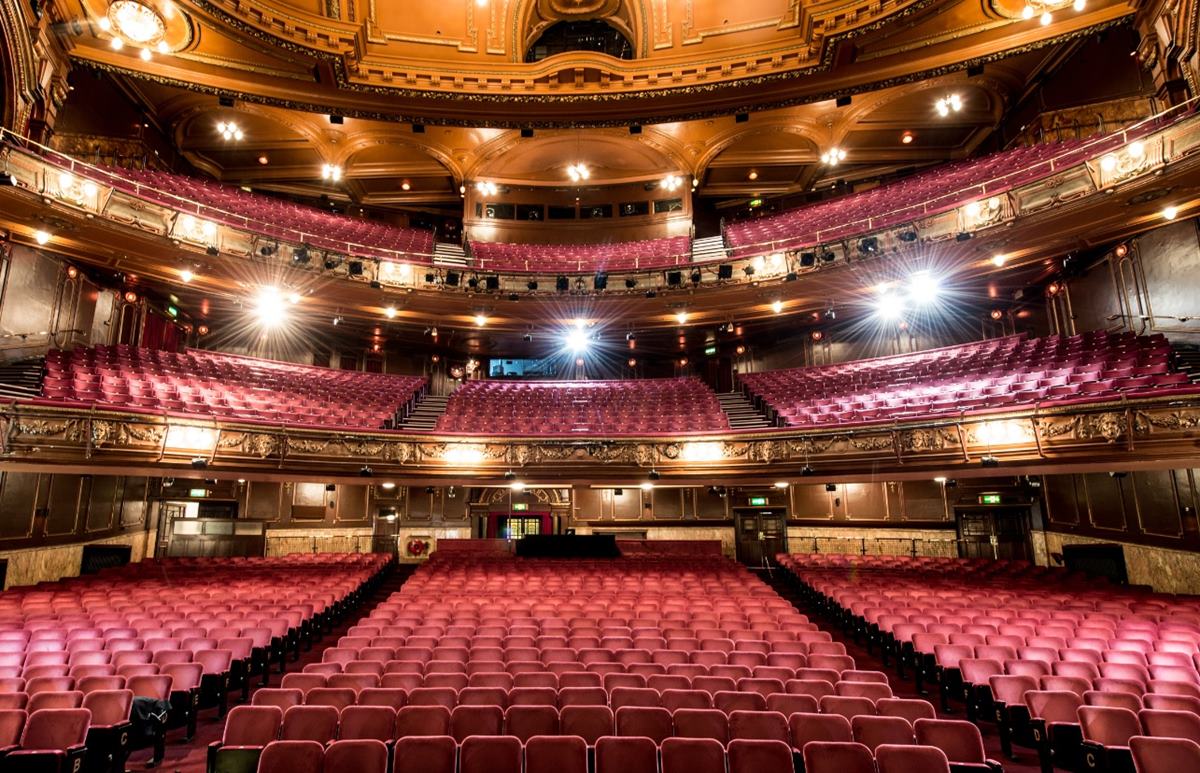
The London Palladium (/pəˈleɪdiˌʊm/) is a Grade II* West End theatre located on Argyll Street, London, in Soho. The theatre was designed by Frank Matcham and opened in 1910. The auditorium holds 2,286 people. Hundreds of stars have played there, many with televised performances. Between 1955 and 1969 Sunday Night at the London Palladium was staged at the venue, produced for the ITV network. The show included a performance by the Beatles on 13 October 1963. One national paper's headlines in the following days coined the term "Beatlemania" to describe the increasingly hysterical interest in the band.[3]
While the theatre hosts resident shows, it is also able to host one-off performances, such as concerts, TV specials and Christmas pantomimes. It has hosted the Royal Variety Performance 43 times, most recently in 2019.
Architecture
Walter Gibbons, an early moving-pictures manager, built the Palladium in 1910 to compete with Sir Edward Moss's London Hippodrome and Sir Oswald Stoll's London Coliseum. The facade (on the site of Argyll House, demolished in the 1860s,[4] from which the pub opposite took the name The Argyll Arms), dates back to the 19th century. Formerly it was a temporary wooden building called Corinthian Bazaar, which featured an aviary and aimed to attract customers from the recently closed Pantheon Bazaar (now the site of Marks & Spencers) in Oxford Street. The theatre was rebuilt a year later by Fredrick Hengler, the son of a tightrope walker, as a circus arena for entertainments that included promenade concerts, pantomimes and an aquatic display in a flooded ring. It then became the National Skating Palace – a skating rink with real ice. However, the rink failed and the Palladium was redesigned by Frank Matcham, a famous theatrical architect who also designed the Coliseum, on the site that had previously housed Hengler's Circus.
The theatre retains many of its original features and was Grade II* listed in September 1960.[5] The building now carries Heritage Foundation commemorative plaques honouring Lew Grade and Frankie Vaughan.
The Palladium had its own telephone system so the occupants of boxes could call one another. It also had a revolving stage.